
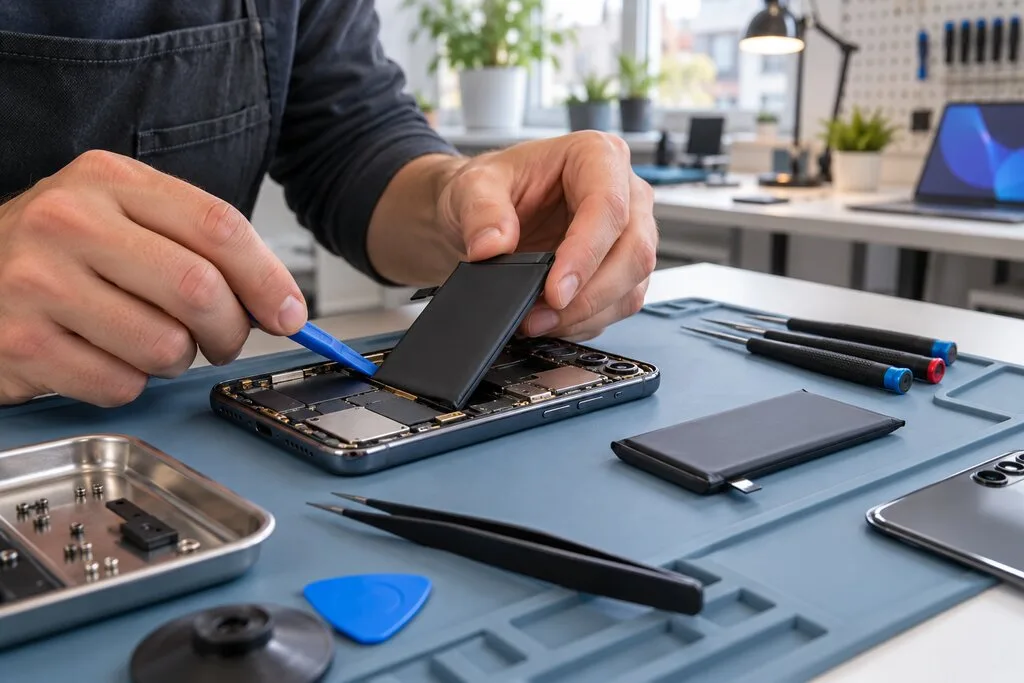
For several years, the European Union has been tightening rules aimed at making electronics more sustainable. Phones play an important role here. In 2026, more provisions of the new EU Batteries Regulation, Regulation (EU) 2023/1542, come into force. They change how the service life of smart devices is approached. Manufacturers must ensure that phone batteries are easier to access and replace.
This article explains the requirements the EU is placing on manufacturers, how they will affect everyday phone use, and why habits in Lithuania should change. Instead of discarding an old phone, choose battery replacement.
What Is Changing Under the New EU Rules
For a long time, phone manufacturers made devices that were difficult to disassemble. They justified this through slim bodies, protection against moisture and dust, and IP standards. Batteries were fixed with strong adhesives and concealed beneath other parts. As a result, replacing a battery at home became almost impossible, while doing so at an unauthorised repair shop often involved risk.
The new EU requirements establish clearer rules.
Accessibility for Users and Technicians
Manufacturers must design devices so that portable batteries can be removed and replaced using ordinary tools available on the market. Without heating. Without specialised solvents.
Supply of Spare Parts
Manufacturers must supply replacement batteries for at least 7 calendar years after the final unit of a particular model is placed on the market.
Clear Information and the Battery Passport
Every battery will have a QR code linked to a digital battery passport. It will provide information on capacity, chemical composition, level of degradation, and recycling.
What this means for you
These changes provide two benefits: lower costs and a longer useful life for the phone. A phone’s service life will no longer depend so heavily on the natural degradation of its lithium-ion battery, which generally becomes apparent after 500 to 800 charging cycles.
One important detail: when battery capacity falls below 80 percent, the operating system often limits processor performance to prevent the phone from shutting down unexpectedly. The phone then appears to be slowing down, creating an incentive to buy a new one even though the display, cameras, and mainboard still work well.
Once the new requirements take effect, repairs will become clearer, safer, and less expensive. The total cost of owning a phone will decrease. Flagship phones such as the iPhone or Samsung Galaxy S series will be practical to use for 5 to 7 years.
Scientific Perspective, the Circular Economy, and Electronic Waste
Academic work on electronic-waste management, which can be found in Google Scholar databases under the topic Circular Economy in Electronics, identifies electronic waste as one of the fastest-growing waste streams.
Researchers emphasise that a large share of a phone’s carbon footprint arises during manufacturing and raw-material extraction. This requires gold, cobalt, lithium, and other materials. Extending a phone’s useful life by one year would reduce greenhouse-gas emissions by an amount comparable to taking millions of cars off the road.
The EU decision to require manufacturers to make batteries easier to replace is based on the right to repair. This principle helps reduce planned device obsolescence.
The Role of Lithuanian Consumers: Refurbish Your Old Phone Instead of Discarding It
In Lithuania, it is still common for a phone with a weakened battery to be left in a drawer or discarded. The owner then gets a new phone under a mobile-operator contract. As the rules change, consumption habits must change too.
If your phone runs more slowly, discharges quickly, or switches off in cold weather, buying a new device should not be the first solution. Replacing the battery is often enough. It is less expensive and more practical.
Consumers in Lithuania should choose a specialised fixas.lt battery replacement service.
Why Choose Battery Replacement at the Fixas Repair Shop
Quality Guarantee
New EU legislation will encourage simpler designs, but disassembling phones currently in use still requires care, knowledge, and equipment. A technician must avoid damaging display flex cables, connections, and moisture seals.
High-Quality Parts
Fixas uses high-quality certified batteries that meet manufacturer standards and allow the device to be used safely.
Less Waste
Replacing the battery extends the phone’s useful life. You save hundreds of euros and reduce the amount of toxic electronic waste.
The 2026 EU requirements for phone batteries benefit consumers and the environment. They reduce excessive consumption and encourage people to use their existing devices for longer. Before buying a new phone, consider battery replacement. It is often a simpler and less expensive solution.
Sources and Recommended Literature
- Regulation (EU) 2023/1542 of the European Parliament and of the Council (2023) concerning batteries and waste batteries, amending Directive 2008/98/EC and Regulation (EU) 2019/1020. Official Journal of the European Union.
- Bakker, C., Wang, F., Huisman, J., & den Hollander, M. (2014). Products that last: product design for circular business models. TU Delft Library. Accessed via Google Scholar.
- Sabbaghi, M., & Behdad, S. (2018). Consumer decisions to repair or replace a product: An empirical study of electronic devices. Resources, Conservation and Recycling, 136, 321–330. Accessed via Google Scholar.
- fixas.lt (2026). Diagnostics of battery degradation in smart devices and technological standards for professional repair in Lithuania.
- European Environmental Bureau (EEB) (2025). Coolproducts report: The environmental impact of smartphones and the benefits of the Right to Repair. Accessed via Google Scholar.
Need help with your device?
If your phone, computer, or tablet is not working properly, bring it to Fixas. We perform quick diagnostics and usually complete repairs within 1–3 hours.